Optimizing Biogas Production Using Methane and Carbon Dioxide Monitoring
Biogas and renewable natural gas (RNG) production depend on a continuously evolving biological process that reacts to even small changes in feedstock composition, organic loading, temperature, and microbial balance. Because of this sensitivity, gas composition becomes one of the most reliable indicators of overall plant performance.
Among the key parameters used to assess anaerobic digestion performance, methane (CH₄) and carbon dioxide (CO₂) provide valuable real-time insight into process stability, gas quality, and energy production potential. Tracking these gases continuously allows operators to move from delayed, reactive troubleshooting toward real-time process control based on actual production behavior.
Table of Contents
-
- The Operational Reality of Biogas Instability
- How Do Methane and CO₂ Trends Indicate Biogas Process Stability?
- How Do Operators Use Gas Signals in Practice?
- Process Optimization Through Continuous Gas Feedback
- Industrial Integration in OEM Monitoring Systems
- Operational Impact of Dual-Gas Monitoring
- Conclusion
The Operational Reality of Biogas Instability
In real-world biogas and RNG facilities, process instability rarely appears suddenly. It develops gradually through small shifts in feedstock quality, loading rate, or microbial stress conditions. The challenge is that these changes are often not visible until they impact methane yield or gas quality.
Without continuous visibility into gas behavior, operators typically rely on indirect indicators such as laboratory samples or delayed process parameters. By the time issues are confirmed, the digester may already be operating below optimal performance.
Gas composition monitoring addresses this gap by providing a direct, real-time reflection of biological activity inside the system.
How Do Methane and CO₂ Trends Indicate Biogas Process Stability?
Methane and carbon dioxide trends provide a direct view of how efficiently the anaerobic digestion process is operating. Rather than relying on isolated measurements, operators gain value from understanding how these two gases evolve over time and how they relate to each other.
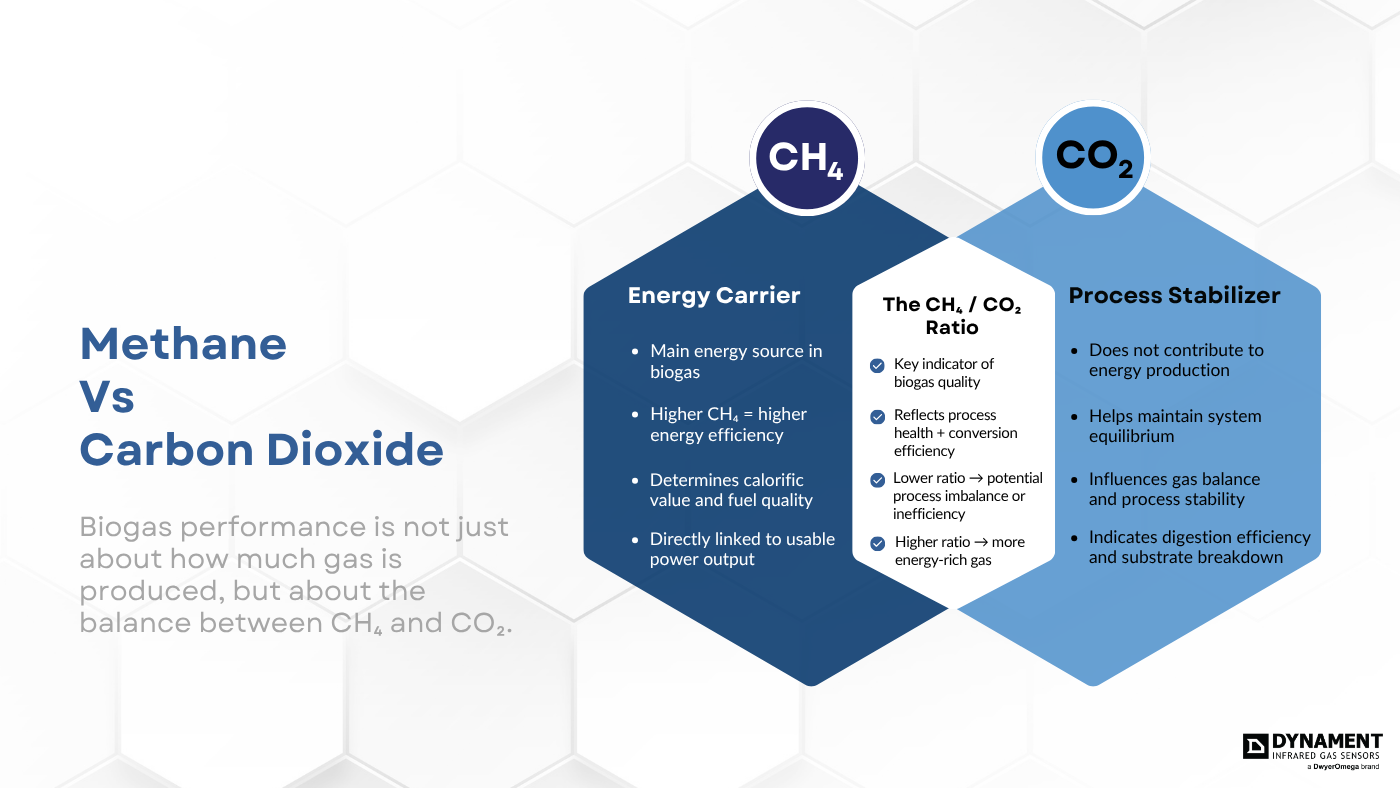
A stable methane trend generally reflects consistent biological activity and efficient conversion of organic matter into energy. When methane begins to decline, it often signals reduced conversion efficiency, inhibition, or the early effects of process imbalance.
Carbon dioxide acts as a complementary process indicator. Gradual increases in CO₂ may reflect changes in biological activity or operating conditions and are often most valuable when evaluated alongside methane trends and other process data. This makes CO₂ particularly useful as an early warning signal.
When both gases are evaluated together, their relationship becomes even more informative. A shifting CH₄/CO₂ balance often provides the first measurable indication that the process is moving away from steady-state conditions. This allows operators to distinguish between normal fluctuations and meaningful process drift that requires intervention.
How Do Operators Use Gas Signals in Practice?
Changes in gas composition can provide an early indication of developing process conditions, helping operators identify potential issues before they affect overall plant performance.
In biogas and RNG facilities, methane and carbon dioxide are not interpreted as isolated values, but as operational signals that guide daily process decisions. Operators typically respond to trends rather than single measurements, using changes in gas composition to assess whether the system is moving toward stability or imbalance.
When methane levels begin to decline while CO₂ gradually increases, this often indicates that conversion efficiency is weakening. In practice, this can lead operators to reduce organic loading or review feedstock composition before a measurable drop in energy output occurs.
If carbon dioxide levels begin to increase relative to methane, this may indicate changes in biological activity or operating conditions that warrant further investigation. Depending on the underlying cause, operators may respond by adjusting feedstock composition, modifying loading rates, reviewing retention times, correcting process chemistry, or optimising mixing conditions.
When the CH₄/CO₂ ratio shifts away from its stable operating range, it is commonly treated as an early warning signal. Operators may use this change to validate whether recent operational adjustments are stabilizing the process or introducing additional stress.
Over time, this approach turns gas composition into a continuous feedback loop, where every change in CH₄ and CO₂ supports more informed and timely operational decisions.
Process Optimization Through Continuous Gas Feedback
Continuous gas analysis is most valuable when used to evaluate how the system responds to operational changes over time. Instead of relying on static measurements, operators can observe how methane and carbon dioxide levels evolve after adjustments to feedstock, loading rate, or temperature.
This enables a more precise understanding of cause and effect within the digestion process. It also helps validate whether operational changes are improving system performance or introducing new instability.
Over time, this data-driven approach supports more consistent methane yield, improved process efficiency, and better predictability of plant output.
Anaerobic Digestion: Early Warning of Biological Imbalance
Anaerobic digestion is highly sensitive to shifts in microbial activity. One of the earliest signs of imbalance is a change in gas composition trends.
A gradual increase in carbon dioxide combined with a weakening methane signal can indicate the onset of acidification or microbial stress. Detecting these patterns early allows operators to intervene before the system reaches a critical state, reducing the likelihood of production loss or digester upset.
This early-warning capability is one of the most valuable outcomes of continuous gas monitoring in biogas systems.
Landfill Gas Recovery: Managing Variability at Scale
In landfill gas recovery systems, gas composition is inherently variable due to heterogeneous waste composition, environmental conditions, and collection efficiency differences across the site.
Continuous monitoring of methane and carbon dioxide helps operators assess collection performance and identify areas where gas capture efficiency may be declining. Changes in methane and carbon dioxide concentrations can also help identify potential air intrusion, which may reduce gas quality, impact recovery efficiency, and influence overall wellfield performance, allowing for targeted operational adjustments.
This improves overall methane recovery efficiency and supports more accurate environmental reporting.
Biogas Upgrading: Ensuring Consistent Feed Quality
In upgrading systems, maintaining consistent gas quality is essential for producing biomethane that meets regulatory and commercial standards.
Methane and carbon dioxide monitoring provides direct feedback on upgrading performance. A decline in methane concentration may indicate methane slip or reduced upgrading efficiency, while fluctuations in CO₂ levels can signal breakthrough or reduced removal efficiency in the upgrading process.
By continuously tracking these variables, operators can ensure stable biomethane quality and reduce deviations that could affect downstream applications such as grid injection or vehicle fuel production.
Enabling Technology: Infrared Gas Measurement
Non-dispersive infrared (NDIR) technology is widely used for methane and carbon dioxide measurement due to its selectivity and stability. It works by measuring the absorption of infrared light at specific wavelengths corresponding to each gas.
This enables continuous, real-time monitoring of gas composition with excellent long-term stability and reduced maintenance requirements compared to alternative measurement approaches.
Industrial Integration in OEM Monitoring Systems
In practical biogas and RNG monitoring systems, compact NDIR sensing modules are widely integrated into OEM gas analysers and control platforms to provide continuous measurement of methane and carbon dioxide under demanding operating conditions.
These environments are typically characterized by high humidity, trace contaminants, and significant temperature variation, requiring sensing technologies with strong long-term stability and resistance to drift.
NDIR-based sensing platforms, including Dynament modules, are commonly adopted within OEM systems to ensure reliable, long-term gas composition monitoring in industrial biogas applications.
Traditionally, methane and carbon dioxide measurements have been implemented using separate sensing elements, increasing system complexity, integration effort, and overall footprint.
Dual-gas NDIR platforms enable simultaneous measurement of CH₄ and CO₂ within a single sensing architecture, helping OEMs reduce component count, simplify system integration, and lower maintenance requirements while maintaining continuous visibility of key process parameters, enabling more compact and efficient gas sensing system architectures for renewable energy applications.
Read also: Simplifying OEM Gas Detection Systems with Dual Gas Infrared Sensors
Operational Impact of Dual-Gas Monitoring
When methane and carbon dioxide data are used as active control signals rather than passive reporting metrics, biogas facilities gain a more responsive and stable operational model.
Early detection of imbalance reduces the likelihood of digester upsets, while continuous feedback enables more precise control of feedstock and loading strategies. Over time, this leads to improved methane yield, more stable gas quality, and reduced downtime associated with process recovery.
This shift from reactive monitoring to continuous optimization represents a significant improvement in how modern biogas and RNG systems are operated.
Conclusion
Biogas production is ultimately a dynamic biological system where small changes can have significant operational consequences. Continuous monitoring of methane and carbon dioxide transforms gas composition into a practical control variable rather than a simple output measurement.
By using CH₄ and CO₂ data to detect imbalance early, guide operational adjustments, and validate process stability, biogas and RNG facilities can improve efficiency, increase energy yield, and maintain consistent gas quality across the entire production lifecycle.
To learn more about integrated gas sensing solutions for biogas and RNG applications, explore our sensing technologies:
Dual Gas Infrared Sensor for Hydrocarbons & CO₂ | Dynament
Low-Power Dual-Gas HC + CO₂ Sensor | Dynament
For further information on methane and carbon dioxide monitoring solutions for biogas and RNG applications, or to discuss specific sensing requirements with our technical team, contact our experts today.
