
Designing Continuous Soil N₂O Monitoring Systems for Agricultural Applications
Soil nitrous oxide (N₂O) emissions are highly variable and can change significantly following rainfall, fertilizer application, irrigation, or seasonal shifts. Because these emission events are often short-lived, periodic sampling may fail to capture the full picture of soil behaviour.
Continuous soil monitoring systems overcome this limitation by providing high-frequency measurements that allow researchers and environmental monitoring organizations to capture emission dynamics as they occur. For OEM manufacturers developing agricultural and environmental instrumentation, this creates the need for sensing technologies capable of supporting extended field deployments under changing environmental conditions.
Capturing these short-lived events requires monitoring systems capable of delivering accurate measurements over extended periods and under changing field conditions.
Contents:
- Why Continuous Monitoring Matters
- Typical Applications of Continuous Soil Monitoring
- Why Continuous Soil Monitoring Is Different from Periodic Sampling
- Typical Architecture of a Soil N₂O Monitoring System
- What Makes an N₂O Sensor Suitable for Field Deployment?
- Recommended Solution for OEM Soil Monitoring Systems
- Why OEMs Choose Compact NDIR Sensors
- Example Application: The Pondi Monitoring Platform
Why Continuous Monitoring Matters
Soil N₂O emissions often occur as short-lived peaks following rainfall, irrigation, or fertilizer application. Capturing these events is essential for producing representative datasets and understanding how agricultural practices influence greenhouse gas emissions.
|
Monitoring Benefit Capture emission peaks Improve long-term dataset Reduce manual intervention |
Practical Value Detect short-lived N₂O events that periodic sampling may miss. Produce more representative data for seasonal studies and emissions modeling. Minimize field visits while maintaining consistent sampling protocols. |
Typical Applications of Continuous Soil Monitoring
Continuous soil monitoring supports a wide range of agricultural and environmental applications where understanding emission dynamics is essential for research, reporting, and long-term process evaluation.
Agricultural Research
Supporting fertilizer trials, soil management studies, and long-term emissions research.
Carbon Farming and GHG Monitoring Projects
Providing N₂O emissions data to support broader greenhouse gas accounting, monitoring and verification activities.
Environmental Monitoring
Monitoring emissions from agricultural soils, wetlands, and managed ecosystems.
Regenerative Agriculture
Evaluating how farming practices such as reduced tillage, cover crops, and improved nitrogen management influence greenhouse gas emissions.
Explore more: N₂O Monitoring Applications Across Industries | Dynament
Why Continuous Soil Monitoring Is Different from Periodic Sampling
| Periodic sampling | Continuous Monitoring |
| Measurements collected at scheduled intervals | Automated measurements collected at frequent intervals |
| Provides snapshots of conditions at the time of sampling | Provides a time series showing how emissions change between sampling events |
| Limited temporal resolution | High-frequency datasets |
| Higher risk of missing emission peaks | Captures short-term emission events |
| Labour intensive | Reduced manual intervention during extended deployments |
Typical Architecture of a Soil N₂O Monitoring System
A continuous soil monitoring platform combines several subsystems that must operate reliably under field constraints such as limited power, humidity, temperature variation, and intermittent connectivity. The exact architecture depends on the measurement method and application, but typical systems may include:
Flux chamber
A chamber with known geometry used to capture changes in gas concentration above the soil surface. Automated systems may incorporate controlled opening and closing to support repeated measurement cycles.
Gas path/gas chamber
Tubing and associated components used to transfer the sample between the chamber and sensing system. The design should minimise leakage, dead volume, and unwanted interaction with the sample gas, with moisture management incorporated where required.
Gas Flow
Depending on the measurement architecture, pumps, flow restriction, or other flow-control components may be used to provide consistent sample delivery to the sensing system.
Sensor/analyser
An N₂O measurement module selected to provide the required measurement range, stability, and environmental operating capability for the application.
Data Acquisition
A data logger or embedded controller records N₂O measurements alongside relevant system and environmental data such as chamber state, soil temperature, soil moisture, rainfall, and atmospheric conditions.
Communications
Where remote operation is required, cellular, LoRaWAN, satellite, or other communications can provide remote data access, system diagnostics, and configuration.
What Makes an N₂O Sensor Suitable for Field Deployment?
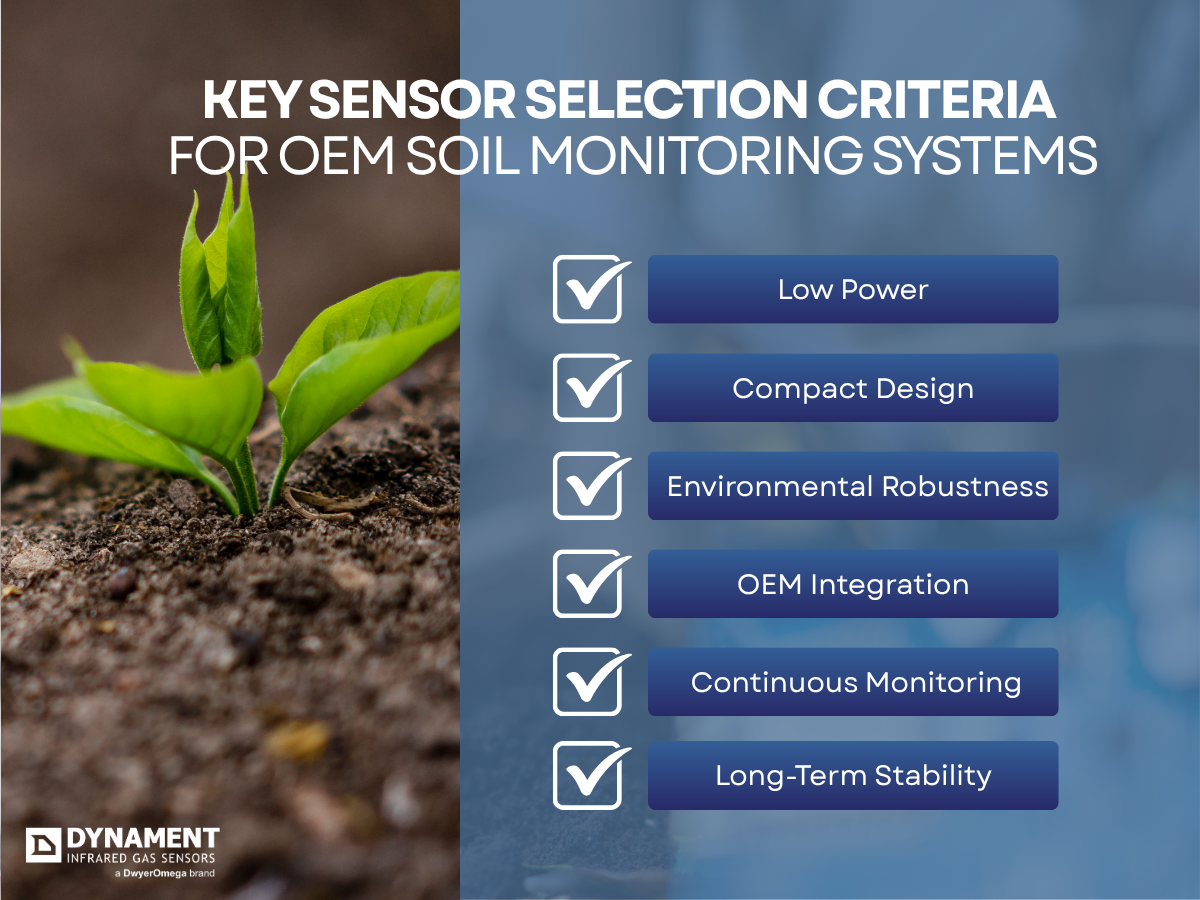
Field deployment is primarily an engineering problem: power budgets, enclosure design, moisture exposure, and maintenance intervals often determine whether a platform can operate reliably between scheduled maintenance and calibration intervals. CO₂ cross-sensitivity should also be considered when designing soil flux chamber systems, as CO₂ concentrations can change during a measurement cycle and may influence the N₂O signal. System-level correction and appropriate data processing can help account for this effect where required.
- Low power: supports battery/solar systems and enables higher sampling frequency without oversized power packs.
- Compact size: simplifies chamber integration and shortens gas lines, reducing dead volume and response time penalties.
- Long-term stability: supports consistent measurement performance between scheduled calibration intervals and across extended deployments.
- Humidity performance: Sensors are tested at 90% RH during production to verify that humidity response remains within defined acceptance limits. The specified operating range is 0–95% RH, non-condensing. During continuous operation, sensor self-heating typically raises the sensor temperature above ambient, helping to reduce the risk of condensation; however, system designers should ensure that non-condensing operating conditions are maintained throughout deployment.
- OEM integration: clear electrical interfaces, robust mechanical integration, predictable warm-up behavior, and accessible documentation for faster instrument development.
Recommended Solution for OEM Soil Monitoring Systems
Dynament Platinum Series N₂O Sensor
Designed for OEM integration, the Dynament Platinum Series combines low power consumption, compact dimensions and integrated temperature compensation for environmental monitoring platforms.
Key Features 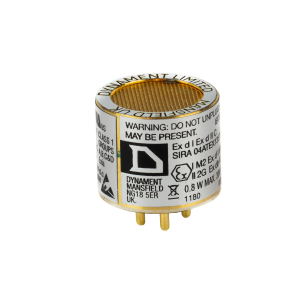
✔ Compact OEM package
✔ Low power operation for battery or solar systems
✔ Stable long-term NDIR measurement
✔ Straightforward OEM integration
✔ Proven integration in autonomous field-monitoring platforms
Designed for battery-powered environmental monitoring platforms that require long-term stability, low power consumption, and straightforward OEM integration.
The sensor is one component of a complete monitoring platform, but its performance directly influences measurement stability, power consumption, system maintenance requirements and overall measurement reliability. For these reasons, OEM developers typically prioritize sensor selection early in the design process.
Typical applications include:
- Automated soil flux chambers
- Agricultural greenhouse gas monitoring and carbon-farming MRV systems
- Environmental monitoring stations
- Greenhouse gas research platforms
- Autonomous agricultural monitoring systems
Why OEMs Choose Compact NDIR Sensors
Compact NDIR sensors can be well suited to environmental monitoring platforms because they combine stable measurement performance with relatively low power consumption and straightforward OEM integration.
Dynament’s Platinum Series N₂O sensors are designed specifically for OEM integration, combining compact dimensions, low power consumption, and stable long-term performance for environmental monitoring equipment.
For OEM instrument builders, this typically translates into simpler enclosure design, easier power provisioning, and a cleaner pathway to scalable manufacturing.
Example Application: The Pondi Monitoring Platform
The Pondi project demonstrates how a compact NDIR N₂O sensor can be integrated into an autonomous monitoring platform designed for long-term greenhouse gas measurements.
Developed for agricultural and environmental research, the system combines automated chambers, embedded sensing, solar power, and cloud connectivity to deliver continuous field measurements with minimal operator intervention.
Read our case study: How Dynament’s Platinum N₂O Sensor Enabled Autonomous Greenhouse Gas Monitoring with the Pondi Platform.
Conclusion
As continuous environmental monitoring becomes increasingly important for agricultural research, carbon farming, and greenhouse gas reporting, OEM manufacturers require sensing technologies that combine measurement stability with straightforward system integration.
Dynament’s Platinum Series N₂O sensors are designed to support these requirements, enabling compact, low-power monitoring platforms for long-term field deployment.
Selecting the right sensing technology at the design stage simplifies integration while supporting reliable, long-term environmental measurements.
Explore the Dynament Platinum sensor or contact our engineering team to discuss integration requirements for your environmental monitoring platform.
