Nitrous oxide (N₂O) is no longer monitored only by climate researchers. Today, it plays an important role across industries including agriculture, chemical manufacturing, healthcare, and scientific research, where accurate measurement supports emissions reporting, process optimization, worker safety, and regulatory compliance.
Unlike many industrial gases, N₂O is monitored for multiple purposes depending on the application. It may be used to measure greenhouse gas emissions, optimize industrial processes, protect workers from occupational exposure, or support scientific research. As a result, sensor requirements vary significantly in terms of measurement range, accuracy, response time, and operating conditions.
Table of contents
- Where Is Nitrous Oxide Monitored?
- What Is Nitrous Oxide and Why Is It Monitored?
- Why Monitoring Requirements Differ Between Applications
- What Makes N₂O Monitoring Challenging?
- How Do You Choose the Right N₂O Sensor?
- The Growing Role of N₂O Monitoring Across Industries
- Explore N₂O Monitoring in More Detail
- Frequently Asked Questions (FAQ)
Where Is Nitrous Oxide Monitored?
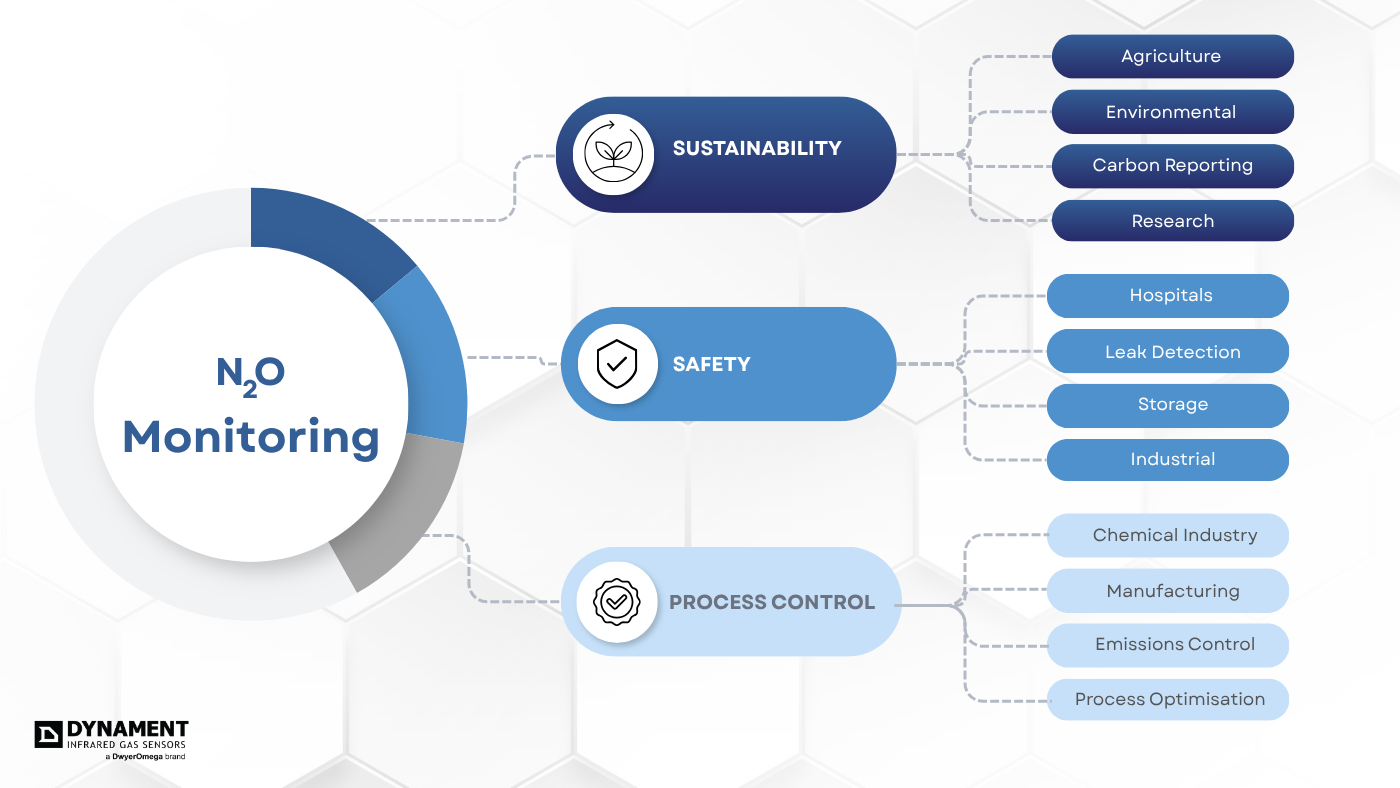
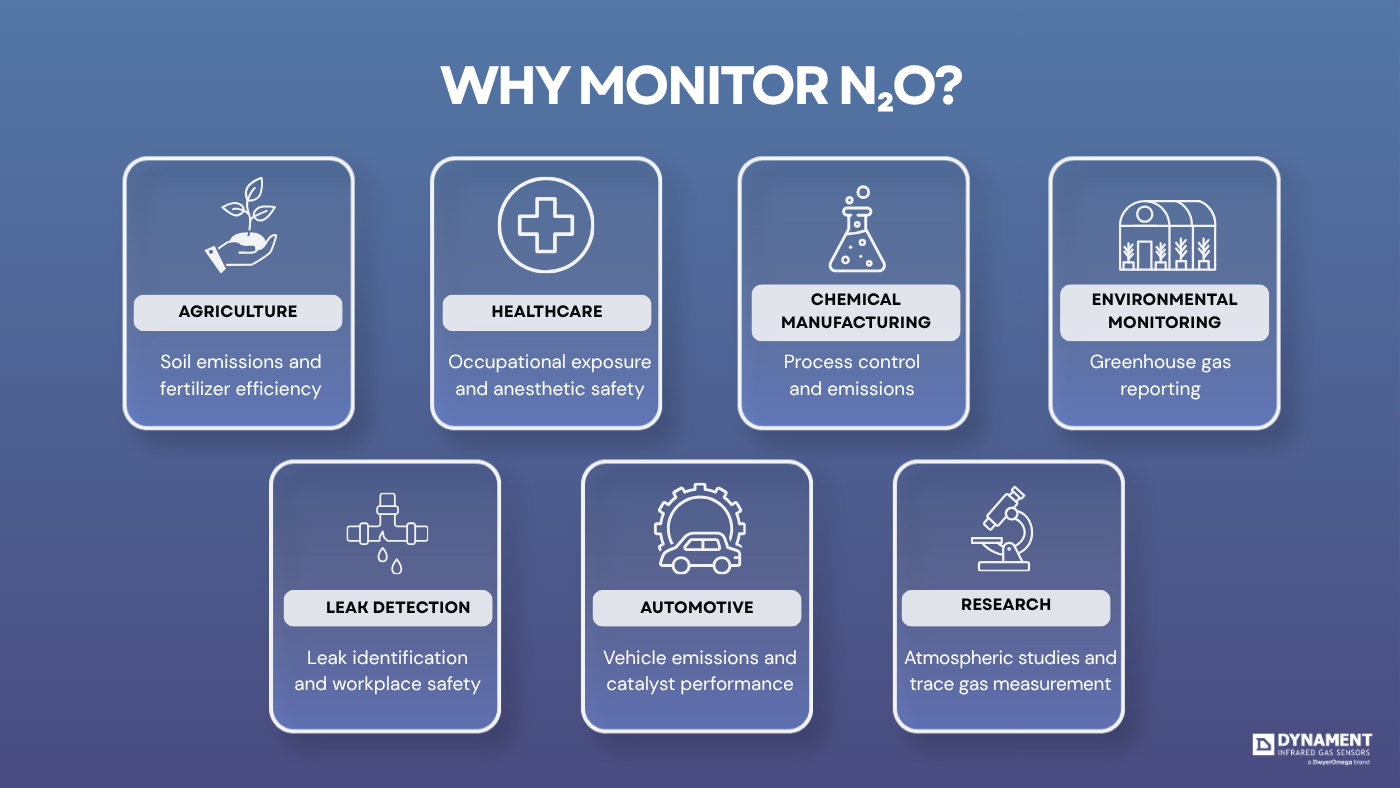
Nitrous oxide is monitored across a wide range of industries, with measurement requirements varying according to the application. The table below highlights the main sectors where N₂O monitoring is used and the primary purpose of measurement.
| Industry | Typical monitoring objective | Why measurement matters | |
| Agriculture | Measure soil N₂O emissions, evaluate fertiliser strategies, and support greenhouse gas and carbon reporting. | Fertilizer efficiency & carbon reporting | |
| Healthcare | Monitor occupational exposure and detect anesthetic gas leaks. | Worker safety | |
| Industrial Manufacturing | Optimize chemical processes and verify emissions control systems. | Process optimization | |
| Environmental Monitoring | Support greenhouse gas inventories and climate research. | GHG reporting | |
| Safety & Leak Detection | Detect unintended releases in storage and industrial facilities. | Safety | |
| Automotive & Engine Testing | Measure combustion-related emissions during testing. | Emissions analysis | |
| Research & Laboratories | Perform high-precision atmospheric and scientific measurements. | High-precision measurement |
What Is Nitrous Oxide and Why Is It Monitored?
Nitrous oxide (N₂O) is a naturally occurring gas produced through biological processes in soils and oceans, but it is also widely used in industrial, environmental, medical, and scientific applications. Although present in much lower concentrations than carbon dioxide, N₂O has a significantly higher global warming potential and a long atmospheric lifetime, making it one of the key greenhouse gases to monitor.
Beyond its environmental impact, N₂O monitoring supports industrial process optimization, emissions control, workplace safety, and scientific research. As sustainability initiatives and regulatory requirements continue to grow, reliable nitrous oxide measurement is becoming increasingly important across multiple industries.
Why Monitoring Requirements Differ Between Applications
Although the same gas is being measured, N₂O monitoring requirements vary significantly between applications. Factors such as concentration range, operating environment, response time, accuracy, and regulatory requirements all influence how monitoring systems are designed.
For example, environmental monitoring often focuses on trace concentrations for emissions reporting and climate research, while industrial processes require continuous measurement under demanding conditions. Healthcare applications prioritize occupational exposure monitoring, whereas research laboratories place greater emphasis on measurement stability and repeatability.
Because concentration levels can vary widely across these applications, selecting the appropriate measurement range is often one of the most important considerations when choosing an N₂O sensor. The following sections explore the most common applications and their monitoring challenges.
What Makes N₂O Monitoring Challenging?
Monitoring nitrous oxide presents several challenges. N₂O is often present at relatively low concentrations and absorbs infrared radiation less strongly than gases such as carbon dioxide. This can make sensitive and stable measurement challenging, particularly in applications requiring low detection limits.
Measurement requirements also vary widely between applications. Concentration ranges can span from trace atmospheric levels to high process emissions, while operating conditions differ significantly between outdoor environments, industrial facilities, and research laboratories. These factors influence sensor selection, calibration, and long-term measurement performance.
The following applications highlight the different monitoring challenges across industries.
Agriculture and Soil Emissions
Agriculture is one of the largest sources of nitrous oxide emissions, primarily due to microbial processes in fertilized soils. Emissions are influenced by factors such as nitrogen application, soil moisture, temperature, and oxygen availability.
Direct N₂O measurement helps researchers and agricultural professionals quantify emissions more accurately than estimation models alone. The resulting data supports greenhouse gas inventories, evaluates emission reduction strategies, and improves nitrogen-use efficiency.
Typical applications include:
- measuring soil emissions after fertilizer application or rainfall;
- evaluating emission reduction strategies;
- supporting carbon reporting and life-cycle assessments.
Medical and Healthcare Facilities
Nitrous oxide is used as an anaesthetic gas in healthcare and dental environments, where unintended releases can contribute to occupational exposure. Monitoring can therefore form part of broader safety and gas management strategies alongside engineering controls such as anaesthetic gas scavenging systems. N
Healthcare applications can include occupational exposure monitoring, leak detection, and verification of anaesthetic gas scavenging systems. The required measurement range and performance depend strongly on the specific application and applicable exposure limits.
Typical applications include:
- Operating rooms.
- Dental clinics.
- Medical gas storage and distribution systems.
Industrial Manufacturing and Chemical Processes
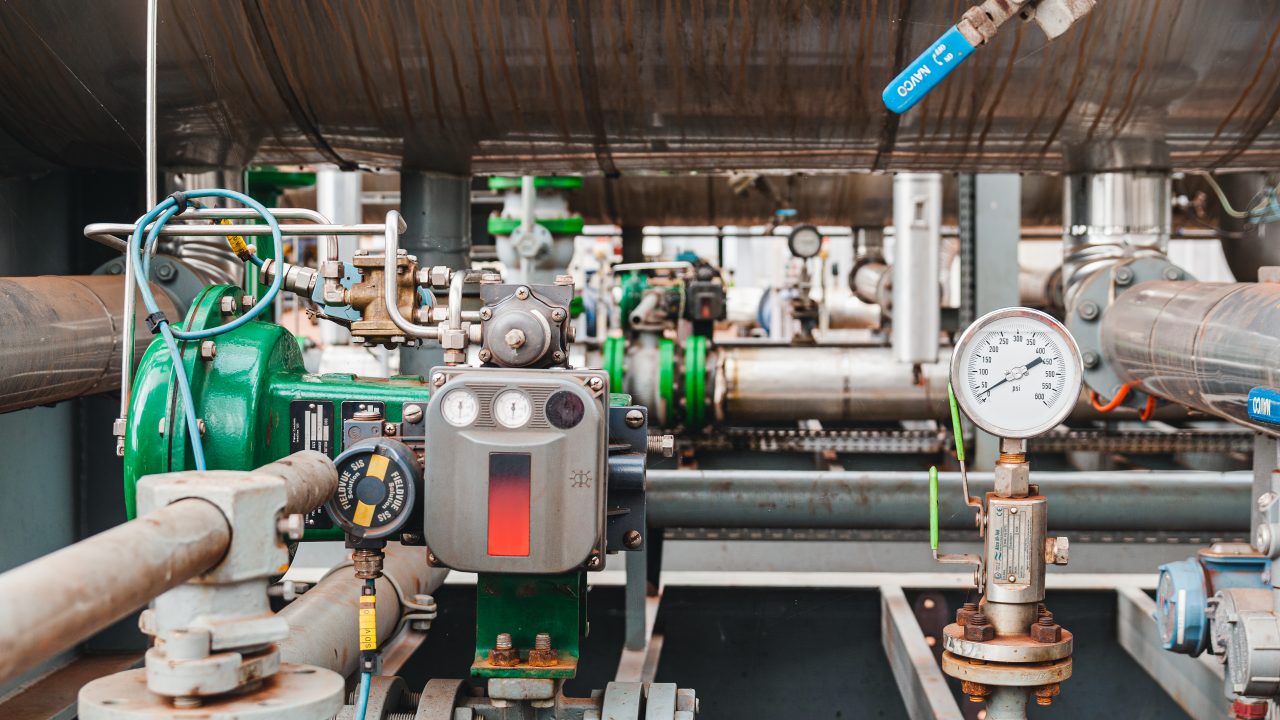
Nitrous oxide monitoring is widely used in chemical manufacturing, particularly in nitric acid production, where N₂O is generated as a process by-product. Monitoring N₂O can help manufacturers evaluate emissions abatement performance, support process optimisation, and verify that treatment systems are operating as intended.
Nitric acid production is a particularly important application for N₂O monitoring, as emissions can be generated throughout the production process and require effective monitoring and abatement.
Typical applications include:
- Nitric acid production.
- N₂O emissions monitoring
- Emissions abatement verification
- Process optimisation
Environmental Monitoring and Emissions Reporting
Environmental monitoring is one of the main drivers of N₂O measurement, supporting climate research, greenhouse gas reporting, and emissions reduction initiatives. Nitrous oxide is monitored in both ambient air and industrial emission sources to generate accurate, long-term emissions data.
Because these applications often involve measuring low concentrations over extended periods, they require highly stable and reliable monitoring systems.
Typical applications include:
- Greenhouse gas monitoring programs.
- Industrial stack emissions.
- Atmospheric research stations.
- Environmental impact assessments.
- Verification of emissions reduction initiatives.
Safety and Leak Detection
In safety applications, the objective is not to quantify emissions but to identify unintended releases in environments where N₂O is stored, distributed, or used. Nitrous oxide monitoring can help identify potential releases and support the assessment of gas-handling systems, with the appropriate sensing range and measurement performance selected according to the specific safety requirement.
Depending on the application, monitoring may be continuous or carried out during routine inspections and maintenance activities.
Typical applications include:
- gas storage facilities
- Gas distribution systems
- production and processing equipment
- industrial gas safety programs
Research and Laboratory Applications
Research laboratories use N₂O measurement for applications including atmospheric chemistry, climate science, environmental research, and industrial process studies. Measurement requirements can vary substantially depending on the application, ranging from field-oriented monitoring to high-precision analytical measurements.
Typical applications include:
- Atmospheric chemistry.
- Climate research.
- Trace gas analysis.
- Calibration studies.
- Combustion and environmental research.
How Do You Choose the Right N₂O Sensor?
Selecting the right N₂O sensor starts with understanding the application’s measurement requirements. Factors such as concentration range, operating environment, response time, and long-term stability all influence which sensing solution is most suitable.
Key considerations include:
- Measurement range – Expected N₂O concentrations vary significantly between environmental, industrial, medical, and research applications.
- Measurement stability – Essential for long-term monitoring, emissions reporting, and scientific research.
- Operating environment – Temperature, humidity, dust, vibration, and other environmental conditions can affect sensor performance.
- Response time – Fast response is important for applications such as leak detection and process control.
- System integration – Compatibility with OEM equipment and control systems simplifies deployment.
- Maintenance requirements – Calibration intervals, reliability, and sensor lifetime influence the total cost of ownership.
Because no single sensing technology is suitable for every application, selecting the right sensor requires balancing measurement performance with system integration and operational requirements. For OEM manufacturers, making this decision early in the design process can simplify integration and improve long-term performance.
Although several factors influence N₂O sensor selection, the required measurement range is typically the primary consideration. Once the target concentration range has been established, factors such as operating environment, long-term stability, response time, and system integration help determine the most appropriate sensing configuration.
The Growing Role of N₂O Monitoring Across Industries
Nitrous oxide monitoring has evolved far beyond its traditional role in environmental research. Today, it supports applications across agriculture, healthcare, industrial manufacturing, environmental monitoring, and scientific research, where accurate measurement helps improve operational performance, support regulatory compliance, and generate reliable data.
Although monitoring objectives vary across industries, every application requires selecting a sensing solution that matches its measurement range, operating environment, and performance requirements. Factors such as long-term stability, response time, and system integration all play an important role in achieving reliable measurement.
As organizations continue to invest in emissions reduction, process optimization, and sustainability initiatives, demand for accurate and continuous N₂O monitoring is expected to grow. Understanding the requirements of each application is the first step toward selecting a sensing solution that delivers dependable, long-term performance.
Explore N₂O Monitoring in More Detail
Nitrous oxide monitoring requirements vary significantly across applications, from agricultural emissions and industrial process optimization to healthcare safety and environmental research. As a result, selecting the right sensing approach requires understanding the specific operating conditions, concentration ranges, and measurement objectives for each use case.
Our N₂O resource center explores these applications in greater depth, including dedicated guides on agriculture, healthcare, industrial emissions, leak detection, environmental monitoring, and the sensing technologies that enable accurate N₂O measurement.
Need help selecting the right N₂O sensing solution for your application? Contact our team to discuss your measurement requirements and find the right approach for your system.
Frequently Asked Questions
Which Industries Use N₂O Monitoring?
Industries that commonly use N₂O monitoring include:
- Agriculture
- Healthcare
- Chemical Manufacturing
- Environmental Monitoring
- Safety & Leak Detection
- Automotive Testing
- Research & Laboratories
Each industry monitors N₂O for different reasons, from greenhouse gas reporting and process optimization to occupational safety and scientific research.
How is nitrous oxide measured?
Nitrous oxide is commonly measured using infrared-based sensing technologies, including non-dispersive infrared (NDIR) sensors, which detect the gas by analysing its characteristic infrared absorption. The most appropriate measurement technology depends on factors such as concentration range, environmental conditions, response time, and the required level of accuracy.
Can N₂O monitoring support ESG and sustainability initiatives?
Yes. Accurate N₂O measurement helps organizations quantify greenhouse gas emissions, evaluate mitigation strategies, improve carbon reporting, and support wider sustainability and ESG programs. Reliable measurement data is increasingly important as environmental reporting requirements continue to evolve.