Gas detection has shifted from a standalone safety function to a core subsystem in industrial safety monitoring, HVAC infrastructure, and facility-wide monitoring networks. OEM gas detection platforms must now support more target gases, operate in harsher environments, and integrate into smaller, energy-efficient systems.
As a result, OEMs are increasingly prioritising gas sensor platforms that simplify integration and support reliable multi-gas monitoring with fewer components. Dual-gas infrared sensors, commonly based on non-dispersive infrared (NDIR) technology – a method that measures gas concentration using infrared light absorption- address these challenges by consolidating gas measurements into a single platform. This approach can improve integration flexibility and reduce long-term maintenance requirements.
Table of Contents
- Why OEM Gas Detection Systems Are Becoming More Complex
- Multi-Gas Monitoring Requirements Across Industrial Applications
- The Operational Challenges of Multiple Sensor Modules
- What Should OEMs Consider When Choosing an OEM Gas Sensor?
- How Dual-Gas Infrared Sensors Simplify OEM Integration
- Traditional Multi-Sensor Architectures vs Dual-Gas Platforms
- How to Integrate OEM Gas Detection Systems into Existing Safety Infrastructure
- Benefits for Portable Gas Detection Devices
- Broad Application Support for Industrial Safety Monitoring Platforms
- The Role of Dual-Gas Infrared Platforms in Modern OEM Design
- FAQ
Why OEM Gas Detection Systems Are Becoming More Complex
Modern safety and monitoring systems must now detect several gases at once in industrial and commercial spaces. This change affects every part of system development: mechanical and electrical design, assembly, servicing, and ongoing operation.
Multi-Gas Monitoring Requirements Across Industrial Applications
Many environments require overlapping gas monitoring strategies rather than isolated single-gas detection to support industrial safety monitoring and process control.
Examples include:
- HVAC and ventilation systems monitoring CO₂ and combustible gases
- Data centres requiring refrigerant leak detection and environmental monitoring
- Industrial facilities monitoring hydrocarbons and process-related gases
- Renewable natural gas (RNG) and biogas systems requiring simultaneous methane and carbon dioxide monitoring
In many cases, these applications must support multiple sensing functions within the same enclosure or monitoring zone, increasing integration complexity for OEMs.
Renewable natural gas (RNG) and biogas production provide a particularly strong example of why multi-gas monitoring has become increasingly important.
Operators must continuously monitor both methane and carbon dioxide concentrations to assess digester performance, verify gas quality, and support biomethane upgrading processes. In these environments, dual-gas sensing architectures can simplify integration while delivering the process data needed for efficient operation.
The Operational Challenges of Multiple Sensor Modules
Implementing multi-gas monitoring through separate sensing modules can significantly increase system complexity.
Multiple sensing modules typically increase:
- wiring complexity
- connector count
- PCB routing density
- enclosure size
- calibration workflows
- maintenance overhead
Adding more sensing modules complicates validation and increases potential failure points, which can lead to longer assembly, more complex servicing, and reduced scalability in large deployments.
What Should OEMs Consider When Choosing an OEM Gas Sensor?
Selecting the right OEM gas sensor requires balancing sensing performance with integration, maintenance, and deployment requirements.
Key considerations include:
- long-term stability
- integration flexibility
- power consumption
- environmental robustness
- diagnostics capability
- compact mechanical design
How Dual-Gas Infrared Sensors Simplify OEM Integration
Dual-gas infrared sensors combine multiple gas measurements within a single sensing platform. Platforms such as the Platinum Series dual-gas infrared sensors are designed to support simultaneous monitoring of hydrocarbon gases (HC), including methane and propane, alongside carbon dioxide (CO₂) within compact OEM architectures.
Instead of increasing system capability by adding independent sensing modules, dual-gas architectures consolidate sensing functions into a unified optical and electrical design.
This approach can simplify integration while reducing overall system complexity.
Reducing Component Count in Gas Detection Systems
- interface electronics
- wiring requirements
- connector count
- PCB space allocation
- assembly complexity
Infrared sensing technologies are also commonly selected for their stable long-term measurement behaviour, helping reduce maintenance requirements in continuous monitoring environments.
Traditional Multi-Sensor Architectures vs Dual-Gas Platforms
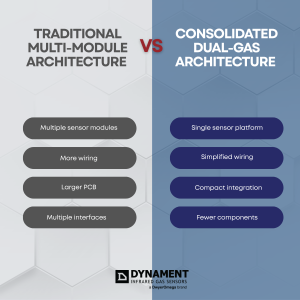
In conventional gas detection systems, each target gas often requires its own sensing module, associated electronics, communication interfaces, and calibration procedures. While effective, this approach can increase system complexity as monitoring requirements expand.
A dual-gas infrared platform simplifies this architecture by consolidating multiple gas measurements into a single sensing solution.
Compared with traditional multi-sensor designs, dual-gas platforms can help OEMs reduce:
- sensor count
- supporting electronics
- PCB space requirements
- wiring complexity
- calibration workflows
- maintenance effort
By reducing the number of discrete sensing components, OEM manufacturers can simplify product development while improving scalability across different monitoring applications.
How to Integrate OEM Gas Detection Systems into Existing Safety Infrastructure
Integrating gas detection into existing safety infrastructure is often more challenging than laboratory-level sensor validation. Many deployments must operate within legacy building management systems, predefined control logic, and constrained commissioning schedules.
Successful integration strategies typically focus on:
- compatibility with existing control systems
- support for analogue and digital communication
- deterministic alarm behaviour
- scalable device addressing
- clear diagnostics and fault reporting
- simplified commissioning procedures
For large deployments, robust diagnostics and consistent device behaviour are critical for reducing downtime and improving operational reliability.
Benefits for Portable Gas Detection Devices
Portable gas detection instruments are often constrained by size, battery life, and integration complexity. By measuring two gases with a single infrared sensor, OEM manufacturers can reduce component count, minimize board space requirements, lower power consumption, and simplify system architecture. These advantages are particularly valuable for handheld instruments, battery-powered monitors, and field inspection equipment.
These advantages make dual-gas infrared sensors particularly attractive for portable gas detectors used in industrial inspections, confined space entry monitoring, utility maintenance, and environmental field assessments.
Broad Application Support for Industrial Safety Monitoring Platforms
Dual-gas sensing platforms can support a wide range of industrial and commercial environments without requiring completely different sensing architectures. For OEMs, this simplifies platform scalability across applications while reducing integration complexity and hardware variation.
HVAC and Building Safety Systems
In HVAC and commercial building environments, gas monitoring supports ventilation control, indoor air quality management, and infrastructure safety. CO₂ monitoring can support demand-controlled ventilation strategies. In contrast, refrigerant or combustible gas detection helps improve operational safety within mechanical spaces and distributed building systems.
Industrial and Energy Infrastructure
Industrial and energy applications often require reliable gas detection under demanding environmental conditions, including vibration, thermal cycling, and exposure to contaminants.
Typical applications include:
- industrial safety monitoring
- refrigeration systems
- process monitoring infrastructure
Simplified multi-gas sensing architectures can help reduce hardware complexity across large-scale or distributed deployments.
The Role of Dual-Gas Infrared Platforms in Modern OEM Design
Modern OEM gas detection platforms increasingly rely on consolidated sensing architectures to support compact integration and multi-gas monitoring.
The integration of dual-gas infrared platforms enables efficient monitoring of hazardous gases, such as hydrocarbons (HCs) and carbon dioxide (CO₂), within a single unit.
Compact non-dispersive infrared (NDIR) platforms also support low-power and space-constrained OEM deployments. As monitoring requirements expand across industrial environments, dual-gas sensing architectures provide a practical approach to reducing hardware complexity.
Manufacturers such as Dynament are developing dual-gas infrared sensing platforms designed to support compact OEM integration and scalable monitoring architectures across industrial applications. These technologies are particularly relevant for applications that require simultaneous monitoring of hydrocarbons and CO₂ on a single sensing platform.
Configurable Sensor Platforms for OEM Development
OEM manufacturers frequently serve multiple industries with different gas monitoring requirements. As a result, platform flexibility has become an increasingly important selection criterion.
Configurable dual-gas infrared platforms allow manufacturers to support different gas ranges and application requirements using a common hardware architecture. Rather than developing separate sensing solutions for each product line, OEMs can leverage a shared platform across industrial safety, environmental monitoring, renewable energy, refrigeration, and portable instrumentation applications.
This approach can reduce engineering effort, simplify product portfolios, and accelerate development cycles while maintaining consistent sensor performance.
Explore how dual-gas sensing technologies support renewable natural gas and biogas monitoring applications in industrial infrastructure.
Additional considerations around dual-gas sensing architectures, NDIR integration strategies, and multi-gas monitoring system design are explored in ours related dual-gas sensing resources.
FAQ
What is an OEM gas sensor?
An OEM gas sensor is a specialised sensing device designed for original equipment manufacturers (OEMs) to incorporate into their products. These sensors detect and measure the presence of specific gases in the environment and are typically integrated into third-party systems such as HVAC units, industrial safety monitoring systems, and environmental control equipment. OEM gas sensors are utilised across various industrial applications, including air quality monitoring, refrigeration system leak detection, and safety systems in manufacturing environments, ensuring regulatory compliance and enhancing operational safety.
What are the benefits of dual-gas infrared sensors?
Dual-gas infrared sensors can reduce component count, simplify wiring and integration, support compact system design, and lower long-term maintenance requirements. They also help OEMs consolidate multiple sensing functions within a single platform.
How do dual-gas sensors reduce OEM system complexity?
By combining multiple gas measurements into a single sensing platform, dual-gas sensors reduce the number of modules, connectors, interfaces, and calibration workflows required in the system architecture.
How can OEM gas detection systems be integrated into existing infrastructure?
Successful integration typically depends on communication compatibility, scalable architecture, deterministic alarm behaviour, and clear diagnostics. Supporting both analogue and digital interfaces can simplify integration into existing building management and industrial safety systems.